Discovery before solution design
Keating Family Medicine, a private primary care practice in Georgia, engaged Solve First Consulting to assess where AI and automation might improve operations. The practice was already getting essential work done. The friction was in repeated checking, manual review and reliance on the person who knew the current status.
I began with a structured workflow intake and a discovery conversation with practice leadership. I documented five opportunities: billing reconciliation, fax processing, prior authorizations, external referrals, and voicemail and refill requests. For each, the Opportunity Map distinguished current workflow, operational impact, possible improvements, implementation complexity and unresolved dependencies.
The assessment did not treat every point of friction as a reason to add AI. Its job was to identify a sensible first move.
Five workflows, two recurring patterns
Prior authorizations, referrals and voicemail requests shared a need for visible ownership, current status and next action. Billing reconciliation and fax handling involved repeated reading, comparison, sorting and routing. Across both themes, knowledge could be held by individuals rather than by a shared process.
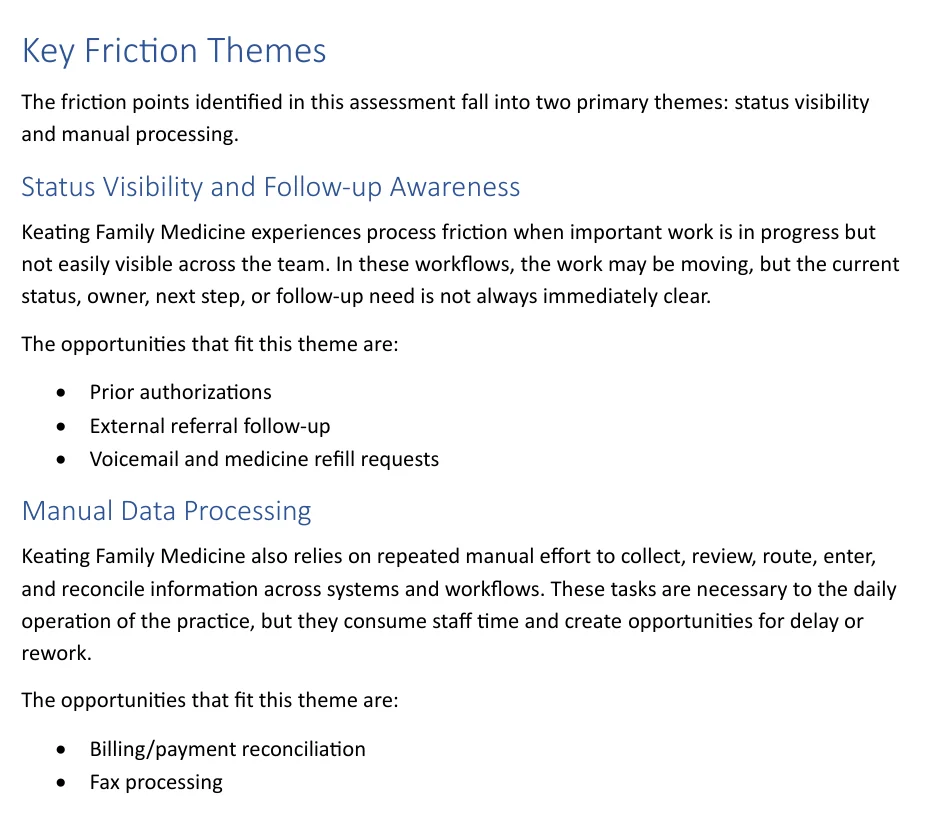
The strongest first investment was a way to manage active work: an owner, a status, a next action and a signal when progress had stalled. Once that operating model worked, automation could be placed around it.
A bounded prior authorization pilot
I recommended a shared Prior Authorization Status Tracker as the first pilot. The practice reported roughly 10–20 prior authorizations per day, making the workflow frequent enough to test. A useful first version would show each item’s owner, status, next action, waiting party and age, with staff-facing notes that could answer status questions without interrupting the person managing the authorization.
Automated submissions, payer-portal access and Epic updates were deliberately outside the first scope. Clinical judgment and submission approval would remain with people. The proposed trial would examine whether staff could answer status questions from the tracker, whether interruptions changed and whether the tracker added work. Those were proposed evaluation measures, not results of an implemented pilot.
“Structure before intelligence.”
From the Opportunity Map’s prior authorization recommendation, report p. 12 / PDF p. 15.
The attractive project I did not recommend
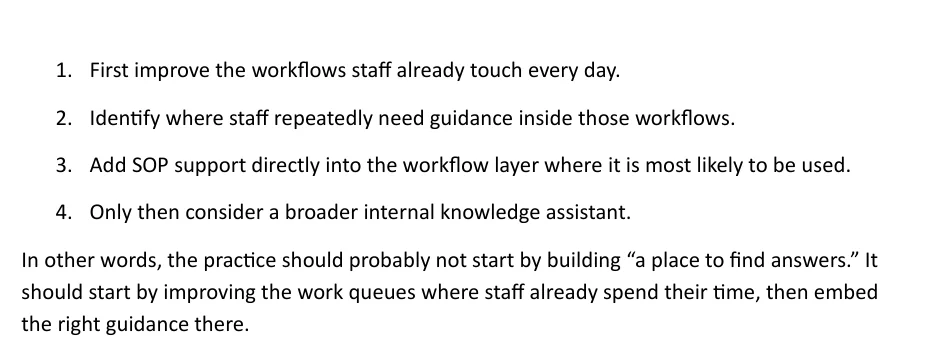
An AI-assisted SOP or knowledge assistant sounded plausible. The practice already had written policies, FAQs, SharePoint and shared folders, yet staff had not consistently used those resources. That pointed toward an adoption and workflow-placement problem. Another destination for answers might become another system people did not use.
I recommended improving the queues staff already touched, identifying the moments guidance was needed, and placing SOP support there. A broader assistant could be revisited later.
The same restraint applied to patient-facing AI, autonomous clinical decisions and deep integrations before the workflow model had been tested.
The assessment was the deliverable
The engagement concluded with delivery of the 38-page Solve First Opportunity Map. It contained five assessments, cross-cutting findings, priorities, explicit deferrals and a proposed first pilot. The contracted work was the assessment; no implementation followed it. The result was a documented basis for deciding what to validate and build first, not a claim of operational savings.